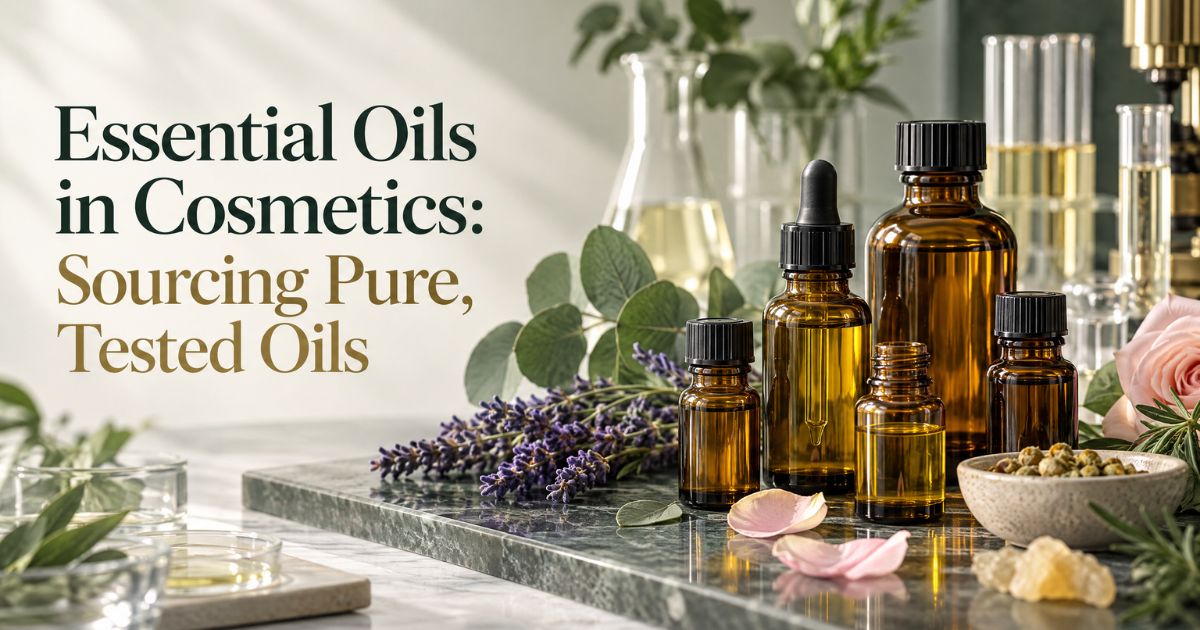
Natural essential oils are concentrated plant extracts obtained through steam distillation, cold pressing, or similar methods. When cosmetic manufacturers source these oils, the label “pure” or “natural” alone does not confirm authenticity, safety, or suitability for a finished product. Verifying an oil’s identity, composition, and documentation is the only reliable way to protect your formulations, your brand, and your customers.
This guide covers what cosmetic manufacturers and ingredient buyers should look for when evaluating essential oils — from quality documentation and authenticity checks to formulation safety and supplier evaluation.
What Are Natural Essential Oils — and What Are They Not?
Essential oils are volatile aromatic compounds extracted from specific plant parts — leaves, flowers, bark, roots, seeds, or fruit peel. Each oil has a distinct chemical profile determined by the plant species, the part used, and the extraction method.
They are not the same as :
• Fragrance oils — synthetic or semi-synthetic blends created to replicate a scent, with no direct plant origin.
• Carrier oils — non-volatile base oils (such as jojoba, sweet almond, or coconut) used to dilute essential oils before topical application.
• Absolutes — highly concentrated aromatic extracts obtained through solvent extraction, typically from delicate flowers like jasmine or tuberose.
• Oleoresins — solvent-extracted mixtures containing both the volatile and non-volatile components of a plant.
For cosmetic formulations, understanding these distinctions matters because each type has different safety profiles, documentation requirements, and regulatory considerations.
Why “Pure” or “Natural” Labels Are Not Proof of Quality
In the essential-oil trade, terms like “100% pure,” “natural,” and “therapeutic grade” are not regulated in the same way across all markets. A supplier can label an oil as pure without independent verification. For cosmetic-grade sourcing, buyers need to go beyond the label and examine the documentation behind it.
The EDQM’s guidance on essential oils in cosmetic products (published by the European Directorate for the Quality of Medicines & HealthCare) recommends applying defined quality criteria — from raw material selection through production — rather than relying on marketing claims alone.
Essential-Oil Quality Checks: What to Examine Before You Buy
Before placing a bulk order, evaluate the following for each essential oil :
Botanical name and plant part. The oil should be identified by its Latin binomial (e.g., Lavandula angustifolia, not just “lavender“) and the specific plant part (flower, leaf, root). Mislabelling is a common source of specification failures.
Origin and traceability. Where the plant material was grown and harvested affects chemical composition. Some suppliers document origin; this is worth asking about.
Extraction method. Steam distillation, cold pressing, and CO₂ extraction each produce oils with different chemical profiles. The method should be stated on the specification sheet.
Batch or lot identification. Every shipment should carry a unique batch number that ties it to the supplier’s production and testing records.
Product specification and Certificate of Analysis (COA). The COA should report actual test results for the specific batch — not generic or typical values. It should include physical parameters (specific gravity, refractive index, optical rotation) and, ideally, a chemical composition breakdown.
Safety Data Sheet (SDS). The SDS covers hazard classification, handling precautions, storage requirements, and first-aid measures. It is a regulatory document, not a quality document, but it is required for safe handling.
GC-MS analysis. Gas chromatography–mass spectrometry identifies and quantifies the individual chemical components in an oil. It is the most reliable tool for detecting adulteration, confirming identity, and verifying that the oil matches its specification.
Allergen information. Many essential oils contain naturally occurring allergens (such as linalool, limonene, citral, or geraniol) that must be declared under EU cosmetic regulations and many other frameworks.
Packaging, storage, and shelf life. Essential oils degrade when exposed to light, heat, or oxygen. Ask about packaging material (amber glass, aluminium), recommended storage conditions, and expected shelf life.
COA, SDS, and GC-MS: What Each Document Tells You
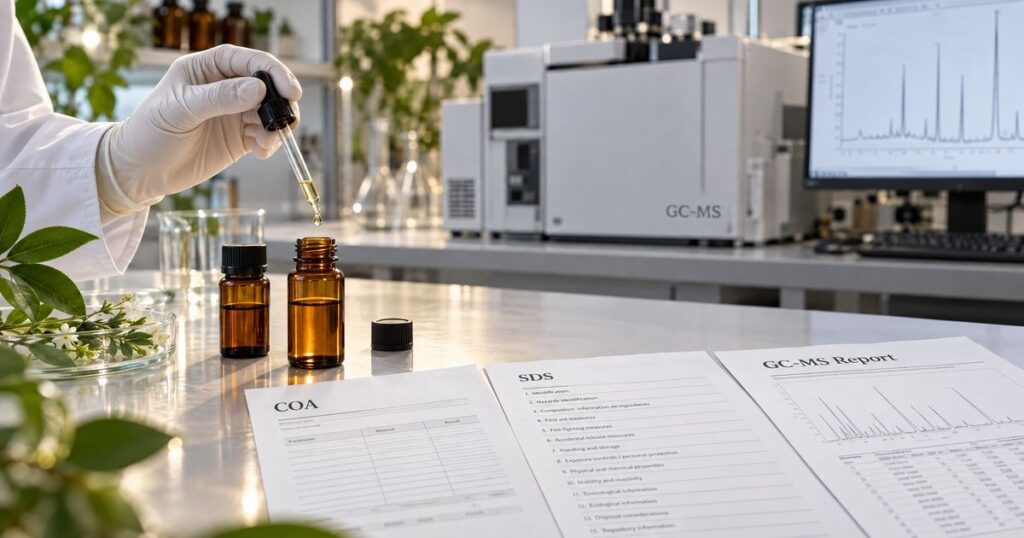
Cosmetic buyers frequently encounter these three documents. Each serves a different purpose :
| Document | What It Tells You | Limitations |
| COA (Certificate of Analysis) | Batch-specific test results against defined specifications — confirms the oil meets its stated quality parameters for that particular lot. | Only as reliable as the testing laboratory; a COA showing “typical” values instead of actual batch data is not batch-specific. |
| SDS (Safety Data Sheet) | Hazard classification, safe handling, storage, disposal, and emergency measures — a regulatory compliance document for workplace safety. | Does not confirm quality, purity, or composition; it is a safety and regulatory document, not a quality assurance tool. |
| GC-MS Report | Detailed chemical composition — identifies and quantifies individual compounds, confirming the oil’s identity and detecting adulteration or contamination. | Requires skilled interpretation; sophisticated adulteration (e.g., adding synthetic linalool to lavender oil) may match expected profiles unless advanced methods such as chiral analysis are used. |
A reliable supplier should be able to provide all three documents for each batch. If a supplier cannot produce batch-specific documentation, that is a significant concern.
Adulteration and Authenticity: What to Watch For
Essential-oil adulteration — diluting or substituting a genuine oil with cheaper materials — is a well-documented concern in the industry. Common methods include:
• Diluting an expensive oil (such as rose or sandalwood) with a cheaper carrier oil or a less expensive essential oil.
• Adding synthetic aroma compounds that mimic the oil’s key constituents.
• Substituting a cheaper botanical species (for example, using Lavandula × intermedia instead of Lavandula angustifolia).
Relying on smell or appearance alone is not sufficient to detect adulteration. Trained noses can catch obvious discrepancies, but sophisticated adulteration is invisible without analytical testing. GC-MS analysis is the industry-standard tool for this purpose, although advanced techniques such as chiral (enantiomeric) analysis and isotope-ratio testing may be needed for high-value oils.
Cosmetic Formulation Considerations
Incorporating essential oils into cosmetic products involves several formulation and safety considerations :
Oxidation and stability. Many essential oils contain terpenes and other compounds that oxidise when exposed to air, light, or heat. Oxidised oils can cause skin sensitisation even when the fresh oil did not. Antioxidants, appropriate packaging, and shelf-life testing are essential.
Compatibility. Essential oils can interact with other formulation ingredients — emulsifiers, preservatives, active ingredients — potentially affecting stability, efficacy, or fragrance performance. Compatibility testing during development is important.
Sensitisation and irritation. Some essential oils (such as cinnamon bark, clove, or oregano) are known skin sensitisers or irritants at certain concentrations. Suitability depends on the specific oil, its concentration, the product type, the intended application area, and the applicable regulatory framework.
Phototoxicity. Certain cold-pressed citrus oils (notably bergamot, bitter orange, and lemon) contain furocoumarins that can cause phototoxic reactions when applied to skin exposed to UV light. The IFRA (International Fragrance Association) sets limits on furocoumarin content — for example, restricting bergapten to 15 ppm in leave-on products applied to sun-exposed skin.
Do not assume that any essential oil is universally safe at any concentration. Safety depends on the specific oil, the formulation, the intended use, the target consumer group, and the regulatory requirements in the destination market.
How to Evaluate an Essential-Oil Supplier
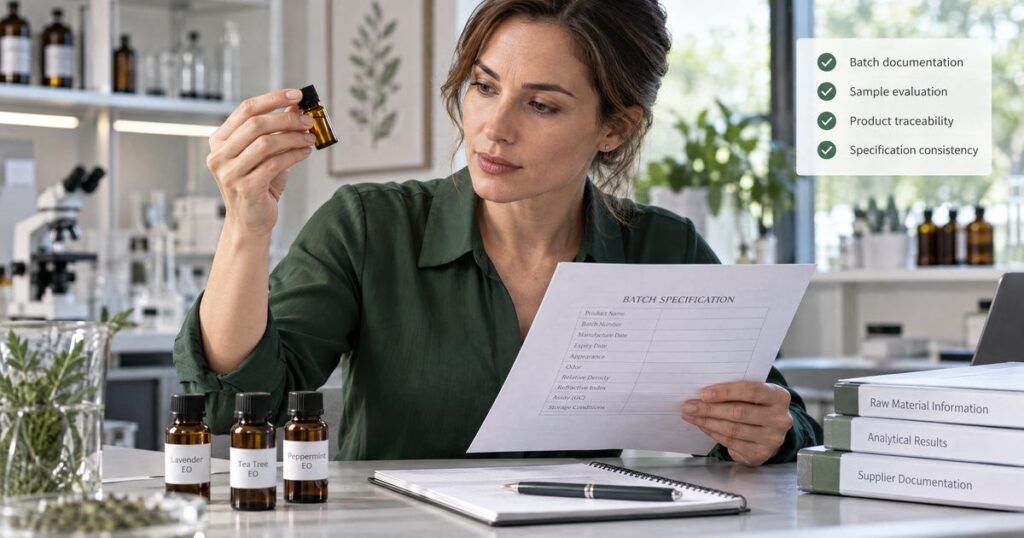
Beyond documentation, assess the following when evaluating potential suppliers :
Specification consistency. Request the product specification before ordering samples. Compare it against the sample test results and then against the batch you receive. A reliable supplier’s batches should consistently match the specification within stated tolerances.
Sample quality. Request a representative sample from a current production batch — not a specially prepared “best” sample. Test it against the specification and your own formulation requirements.
Documentation responsiveness. A supplier who can promptly produce batch-specific COAs, SDS, and GC-MS reports demonstrates established quality processes. Delays or reluctance to share documentation are warning signs.
Traceability. Ask whether the supplier can trace each batch back to its plant-material source, processing date, and testing records.
Regulatory awareness. A supplier serving cosmetic manufacturers should understand the documentation needs of their buyers’ destination markets — whether that involves EU Regulation 1223/2009, US FDA requirements, BIS standards, or other frameworks.
Supplier-Evaluation Checklist
Use this checklist before finalising a bulk essential-oil order :
| Check | Status |
| Botanical name and plant part confirmed on specification | ☐ Yes ☐ No ☐ N/A |
| Extraction method stated | ☐ Yes ☐ No ☐ N/A |
| Batch-specific COA provided (actual results, not typical values) | ☐ Yes ☐ No ☐ N/A |
| SDS available and current | ☐ Yes ☐ No ☐ N/A |
| GC-MS report available for the batch | ☐ Yes ☐ No ☐ N/A |
| Allergen information provided where applicable | ☐ Yes ☐ No ☐ N/A |
| Sample tested and matches specification | ☐ Yes ☐ No ☐ N/A |
| Packaging and storage conditions specified | ☐ Yes ☐ No ☐ N/A |
| Shelf life stated | ☐ Yes ☐ No ☐ N/A |
| Supplier can explain traceability from plant material to finished oil | ☐ Yes ☐ No ☐ N/A |
| Commercial quotation includes packaging, MOQ, and lead time | ☐ Yes ☐ No ☐ N/A |
Common Sourcing Mistakes
• Ordering based on price alone without comparing specifications or requesting batch-specific documentation.
• Accepting “typical” COA values instead of insisting on actual batch test results.
• Assuming all oils with the same common name are identical — botanical species, origin, and extraction method all affect composition.
• Skipping sample evaluation and moving directly to bulk purchase.
• Not asking about allergen content or phototoxicity risks before incorporating an oil into a leave-on formulation.
• Relying solely on organoleptic (smell/appearance) evaluation instead of analytical testing.
Questions to Ask Before Placing a Bulk Order
1. Can you provide a batch-specific COA and GC-MS report for the lot I will receive?
2. What is the botanical species, plant part, origin, and extraction method?
3. What are the key allergens present and at what levels?
4. What are the recommended storage conditions and shelf life?
5. What is your minimum order quantity, and how is pricing structured?
6. Can you provide reference samples from current production batches?
Frequently Asked Questions :
Q1. How do I verify the purity of essential oils for cosmetics?
Request a batch-specific Certificate of Analysis (COA) and a GC-MS report from the supplier. The COA should show actual test results — not “typical” values — and the GC-MS report should confirm the oil’s chemical composition matches its expected profile. For high-value oils, consider requesting chiral analysis.
Q2. What is the difference between a COA, an SDS, and a GC-MS report?
A COA confirms that a specific batch meets defined quality specifications. An SDS provides safety, handling, and hazard information for workplace compliance. A GC-MS report gives a detailed breakdown of the oil’s chemical composition, enabling identity confirmation and adulteration detection. All three serve different purposes and all three should be available.
Q3. Which essential oils are phototoxic?
Certain cold-pressed citrus oils — particularly bergamot, bitter orange, lemon, lime, and grapefruit — contain furocoumarins that can cause phototoxic reactions. The IFRA provides specific concentration limits for these oils in products applied to sun-exposed skin. Steam-distilled citrus oils and rectified (furocoumarin-free) versions generally do not carry the same phototoxicity risk, though this should be confirmed with documentation.
Q4. Does “natural” mean an essential oil is safe for cosmetics?
Not on its own. Natural origin does not guarantee safety, purity, or regulatory compliance. An essential oil’s suitability for cosmetics depends on its composition, concentration in the formulation, the product type, the application area, and the applicable regulations. A thorough safety assessment is always necessary.
Choosing the Right Essential-Oil Partner
Sourcing natural essential oils for cosmetics is not simply about finding the lowest price or the most appealing label. It requires verifying identity, reviewing documentation, understanding formulation constraints, and evaluating supplier reliability.
Satyasha supplies a range of essential oils — including lavender, tea tree, eucalyptus, peppermint, rose, sandalwood, and more — to manufacturers across cosmetics, personal care, and related industries.
For specific requirements, request a quotation : Request a Quote