
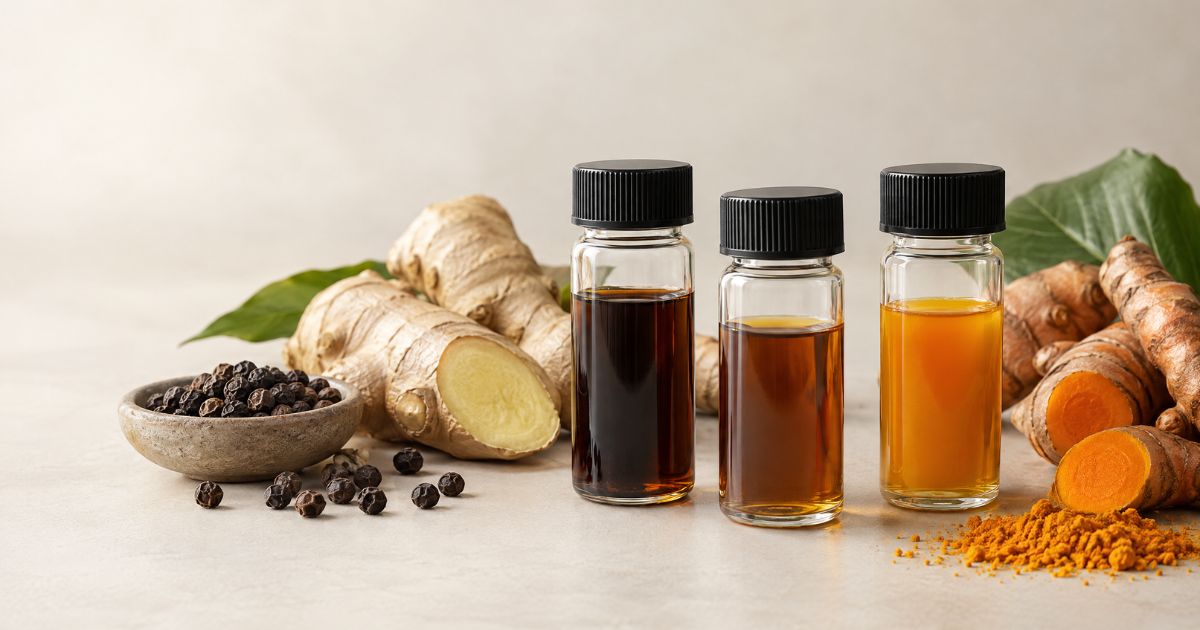
If you manufacture processed foods, seasonings, or flavour blends, you have almost certainly used a spice oleoresin – even if the purchase order simply read “paprika colour” or “pepper extract.” Spice oleoresins are concentrated liquid extracts that capture the complete flavour, aroma, and colour profile of a spice in a standardised, shelf-stable form. Unlike ground spices, which vary by harvest and origin, or essential oils, which contain only volatile aromatic compounds, oleoresins deliver the full sensory character of the source material in a format designed for industrial-scale food production.
This guide explains what spice oleoresins are, how they differ from other spice products, which specification variables matter, and what procurement and export buyers should evaluate before placing a bulk order.
What Are Spice Oleoresins?
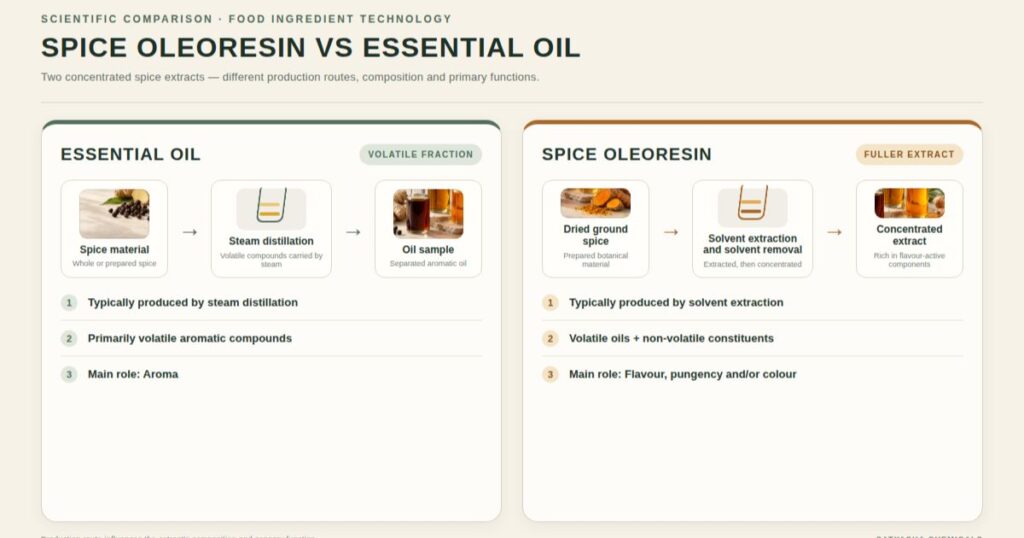
A spice oleoresin is obtained by extracting dried, ground spice material with a food-grade solvent such as ethanol, acetone, ethyl acetate, or hexane. After extraction, the solvent is carefully removed by distillation, leaving behind a concentrated semi-solid or viscous liquid. This extract contains both the volatile essential oil fraction (responsible for aroma) and the non-volatile resinous fraction (responsible for pungency, colour, and other flavour characteristics).
The result is a product that represents the total flavour and colour of the spice, not just its aromatic top notes. This is the critical distinction from an essential oil, which captures only the volatile compounds obtained through steam distillation.
Oleoresins vs Other Spice Products
| Product | Contains | Extraction Method | Primary Function |
|---|---|---|---|
| Whole / ground spice | All plant components including fibre and moisture | Mechanical grinding | Traditional flavouring; visual texture |
| Essential oil | Volatile aromatic compounds only | Steam distillation | Aroma and fragrance |
| Oleoresin | Volatile oils + non-volatile compounds (pungency, colour, fixed oils) | Solvent extraction | Complete flavour, colour, and heat profile |
| Dry soluble / encapsulated | Oleoresin or oil dispersed on a carrier | Spray drying or encapsulation | Easy-to-handle dry form for blending |
For food manufacturers, oleoresins offer several practical advantages over ground spices : consistent active-compound content from batch to batch, significantly lower microbial load, reduced storage volume, longer shelf life, and precise dosing in automated production lines.
Common Applications in Food and Flavour Systems
Spice oleoresins are used across a wide range of food categories. The specific application depends on the oleoresin type, the target product, and the regulatory requirements of the intended market :
• Paprika oleoresin – primarily used as a natural colourant in sauces, processed meats, snack seasonings, cheese products, and dressings. Provides orange-to-red colour without significant heat.
• Capsicum oleoresin – delivers concentrated heat (measured in Scoville Heat Units) for hot sauces, spicy snack coatings, and heat-adjusted seasoning blends.
• Black pepper oleoresin – provides standardised pungency (piperine content) and aroma for soups, ready meals, processed meats, and seasoning mixes.
• Turmeric oleoresin – used for both its yellow-to-orange colour (curcuminoid content) and its mild, earthy flavour in sauces, mustards, and dairy products.
• Ginger oleoresin – provides characteristic pungency (gingerols and shogaols) and warm aroma for beverages, confectionery, and baked goods.
Satyasha supplies oleoresin black pepper, oleoresin ginger, and oleoresin turmeric alongside a comprehensive range of food colours and food flavours.
Key Specification Variables
Oleoresin specifications are product-specific. The parameters that matter for paprika oleoresin (colour value) are different from those that matter for black pepper oleoresin (piperine content). However, most food-grade oleoresin specifications address the following areas :
• Active constituent content – capsaicinoids (capsicum), piperine (black pepper), curcuminoids (turmeric), gingerols (ginger). This determines functional strength.
• Colour value – measured in ASTA units (paprika) or as a percentage of colouring compounds. Essential for oleoresins used primarily as colourants.
• Volatile oil content – percentage of essential oil retained. Affects aroma intensity.
• Residual solvents – must fall within limits set by the applicable food regulation (for example, the US FDA limits under 21 CFR 173.210, or FSSAI limits in India). Typical maximum: 25–30 ppm for hexane.
• Microbiological criteria – total plate count, yeast and mould, E. coli, Salmonella absence.
• Contaminants – heavy metals, aflatoxins, pesticide residues as required by the destination market.
• Carrier and solubility – some oleoresins are supplied on a carrier (vegetable oil, polysorbate) that determines whether the product is oil-soluble, water-dispersible, or both.
• Packaging and shelf life – typically 12-24 months when stored in sealed HDPE drums away from light and heat, though this varies by product.
Product Specification vs Certificate of Analysis
These two documents serve different purposes, and buyers should understand the distinction :
A product specification defines what a product should be. It describes the acceptable ranges for all quality parameters – the standard the manufacturer commits to meeting across all batches.
A Certificate of Analysis (COA) reports what a specific batch actually is. It records the test results for that individual production lot against the specification parameters.
When evaluating a supplier, always request both documents. A specification without COA data offers no evidence of batch-level consistency. A COA without a specification gives no context for whether the reported values are within acceptable limits. Compare COA results across multiple batches to assess consistency before committing to a supply agreement.
How to Evaluate an Oleoresin Supplier
Price alone is an unreliable basis for comparing oleoresin quotations. A lower-priced oleoresin with 20% piperine content is not equivalent to one with 40% — you will use twice the quantity to achieve the same effect. Evaluate quotations by considering :
• Active compound content (strength per unit weight)
• Specification compliance and consistency across sample batches
• Availability and quality of technical documentation (specification sheets, COAs, MSDS)
• Packaging options, minimum order quantities, and lead times
• Sample approval process — request a pre-shipment sample for sensory and analytical evaluation
• Regulatory compliance relevant to your target market (FSSAI, FDA, EU, Codex)
• Traceability and source-material quality controls
Export Purchasing Considerations
Buyers sourcing oleoresins for export or cross-border supply should address the following before finalising an order :
• Destination-country requirements – ingredient permissions and maximum-use levels vary by jurisdiction. An oleoresin approved for food use in India may require different documentation or meet different residue limits in the EU, USA, Japan, or the Gulf states.
• HS code classification – spice oleoresins may fall under HS Chapter 13 (1301.90) or Chapter 33 (3301.90) depending on the product and its declared use. Incorrect classification can lead to customs delays, penalties, or incorrect duty rates. Always verify classification with a qualified customs professional.
• Required documentation – typically includes commercial invoice, packing list, bill of lading, COA, MSDS/SDS, phytosanitary certificate (where applicable), and any destination-specific certificates (health certificate, halal/kosher certification, organic certification).
• Packaging and transport – oleoresins are sensitive to light, heat, and moisture. Verify that packaging meets transport regulations (UN packaging for hazardous goods, if applicable) and provides adequate protection during transit.
• Shelf life at arrival – ensure sufficient remaining shelf life upon delivery to accommodate your own storage and production timelines.
Bulk-Purchase Checklist
Before confirming a bulk oleoresin order, verify the following :
| Checklist Item | Status |
|---|---|
| Product specification reviewed and accepted | ☐ |
| Sample approved (sensory and analytical) | ☐ |
| COA from at least two production batches reviewed | ☐ |
| Active compound content confirmed (price calculated per unit of active content) | ☐ |
| Carrier/diluent confirmed compatible with your formulation | ☐ |
| Residual solvent levels within your regulatory limit | ☐ |
| Microbiological and contaminant limits match destination requirements | ☐ |
| Packaging type and size confirmed | ☐ |
| MOQ, lead time, and payment terms agreed | ☐ |
| Required export documentation listed and confirmed | ☐ |
| HS code verified with customs professional | ☐ |
| Shelf life at delivery calculated and acceptable | ☐ |
Common Procurement Mistakes
• Comparing prices without normalising for active-compound concentration
• Accepting a specification sheet without requesting batch-specific COAs
• Assuming regulatory approval in one market transfers to another
• Neglecting to confirm whether the oleoresin is oil-soluble, water-dispersible, or requires a specific carrier
• Ordering without a pre-shipment sample evaluation
• Not verifying HS code classification before export
FAQs :
Q1. What is the main difference between an oleoresin and an essential oil?
An essential oil contains only the volatile aromatic compounds of a spice, extracted by steam distillation. An oleoresin contains both the volatile oil and the non-volatile compounds (pungency, colour, fixed oils), extracted using a food-grade solvent. Oleoresins represent the complete sensory profile of the spice; essential oils represent only its aroma.
Q2. Are spice oleoresins safe for food use?
Spice oleoresins used in food manufacturing are produced with food-grade solvents and must meet residual-solvent limits set by the applicable food regulation (such as FDA 21 CFR 173.210, EU Regulation 2009/32/EC, or FSSAI standards in India). When produced and used according to these regulations, they are considered safe food ingredients.
Q3. How should oleoresins be stored?
Most oleoresins should be stored below 25–30 °C in sealed, light-resistant containers away from direct heat and moisture. Typical shelf life is 12-24 months from date of manufacture under recommended storage conditions. Always confirm storage requirements with the specific product specification.
Q4. Which oleoresins does Satyasha supply?
Satyasha lists oleoresin black pepper, oleoresin ginger, and oleoresin turmeric on its oleoresins product page. Contact the company directly to confirm current availability, grades, and specifications.
Q5. What documents should I request from an oleoresin supplier?
At minimum : product specification, batch-specific Certificate of Analysis (COA), Material Safety Data Sheet (MSDS/SDS), and any relevant regulatory or certification documents (FSSAI licence, FDA registration, halal/kosher certificates) applicable to your market.
Explore Satyasha’s Oleoresin Range
If your production requires consistent, specification-grade spice oleoresins, view Satyasha’s oleoresin products or request a quote to discuss grades, MOQs, and documentation for your specific requirements.