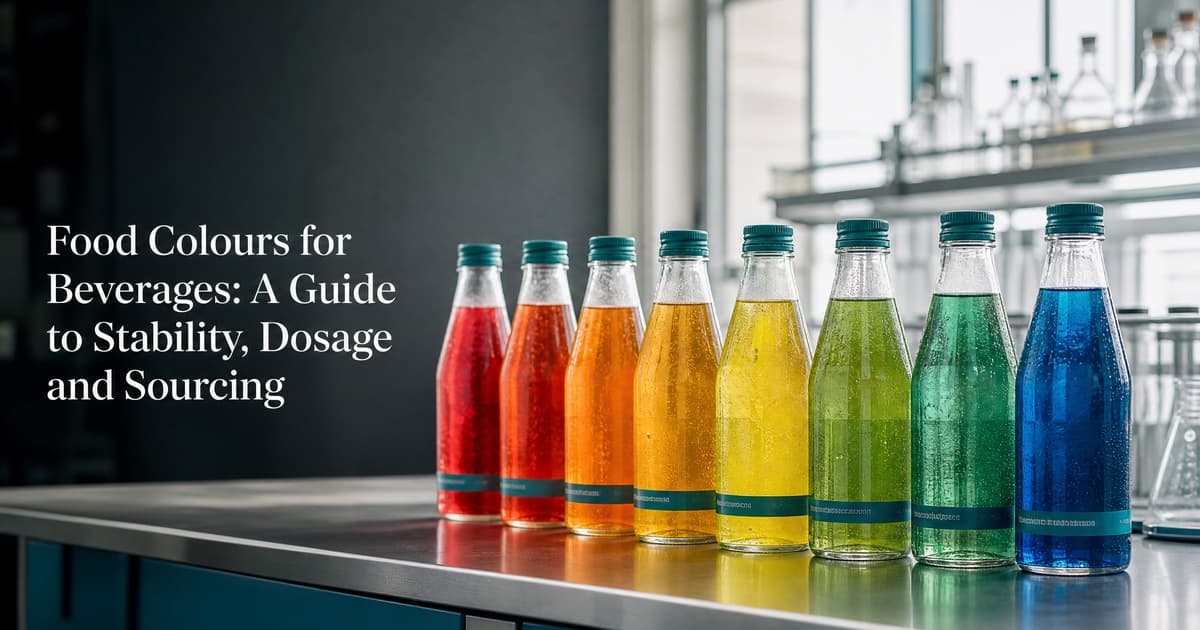
Colour is the first thing a consumer judges in a drink, often before the first sip. For a beverage formulator, though, the question is not only which shade to use but whether that shade will survive a low pH, a pasteurisation step, months under shop lighting, and the ascorbic acid already in the recipe. A food grade colour for beverages has to do more than look right on day one. This guide covers how food colours behave in liquid systems, how dosage is actually decided, and what to check when sourcing.
What “food-grade colour for beverages” means
Food-grade means the colour has been manufactured, purified and documented to be safe for use in food, meeting the applicable standard for identity and purity — including limits on heavy metals and a declared dye content or colour strength. For drinks, one more property matters: solubility. Beverages need water-soluble colours that dissolve cleanly without haze or sediment. Lake colours, which are insoluble, are used in dry mixes and oil-based systems and are rarely the right choice for a clear liquid.
Colours fall into two broad families — synthetic certified dyes, and natural or nature-derived colours such as curcumin, anthocyanins, carotenes and caramel. Both are used across the beverage industry; the right family depends on the product’s positioning, the target shade, and the process the drink goes through.
Synthetic vs natural colours in a drink
Synthetic water-soluble colours are strong, consistent and stable across a wide range of pH and processing conditions, which is why they dominate bright, long-life soft drinks. In India, the FSS (Food Products Standards and Food Additives) Regulations, 2011 permit eight synthetic colours: Ponceau 4R, Carmoisine and Erythrosine (reds); Tartrazine and Sunset Yellow FCF (yellows); Indigo Carmine and Brilliant Blue FCF (blues); and Fast Green FCF. The current list and conditions of use are published by the FSSAI.
Natural colours support a cleaner label but behave differently in a glass. They are generally more sensitive to pH, light and heat, often need higher loadings to reach the same intensity, and can introduce a faint flavour or haze. Neither family is simply “better” — the decision turns on the shade you need, the shelf life you promise, the process, and the budget.
Stability — the four stresses on a beverage colour
Most colour failures in the field trace back to one of four stresses. A colour that looks perfect in a beaker can still fail on a lit shelf three months later, so each of these should be tested on the actual product.
pH
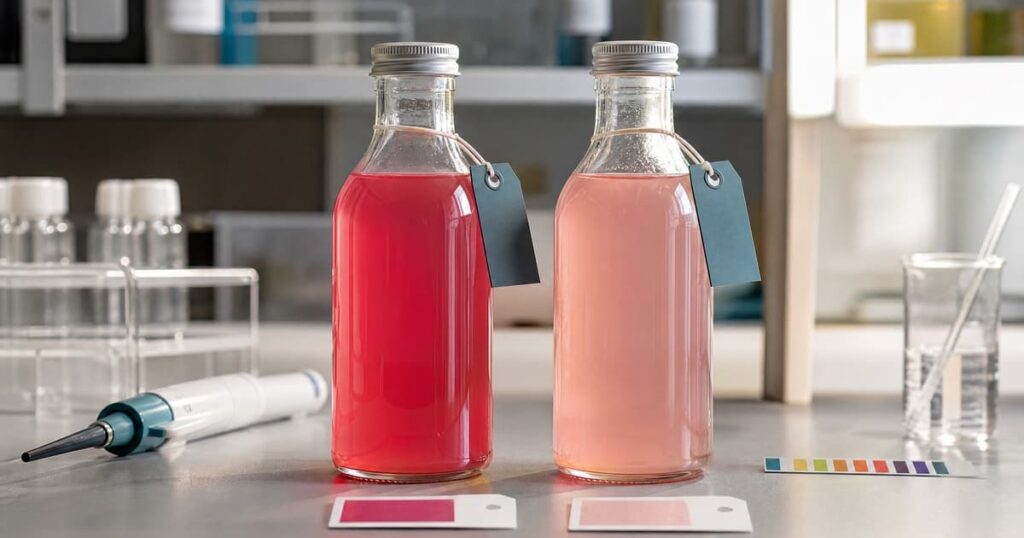
This is the big one for beverages. Anthocyanins — the natural pigments behind many reds and purples — are vivid at low pH and shift toward purple and blue, then fade, as pH rises; they are least stable near neutral. Many synthetic azo dyes hold their shade across a broader pH band, which is part of why they suit carbonated and fruit-acid drinks. Always check a colour’s behaviour at your finished product’s actual pH.
Light
Riboflavin and several natural colours fade under UV, and a clear PET bottle on a bright shelf is the worst-case exposure. Synthetic colours are generally more light-stable, though not immune. If the pack is transparent and the shelf is lit, light-test the real bottle rather than trusting a beaker result.
Heat and processing
Pasteurisation and hot-fill can degrade heat-sensitive natural colours. Confirm the thermal stability of a colour for the specific process temperature and hold time the drink will see, not just for storage.
Ingredient interactions
Ascorbic acid (vitamin C), metal ions, some preservatives and high sugar levels can all accelerate fade or shift a shade. Because these interactions are matrix-specific, the only reliable test is the finished formulation, stored the way the product will actually be stored — cool, dark and sealed for the accelerated and real-time shelf-life trials.
Dosage — why there is no single number
There is no universal dosage for “beverage colour,” and any source that gives you one is oversimplifying. The right level depends on the specific colour and its declared colour strength, the depth of shade you are targeting, the beverage matrix, and whether you are dosing a concentrate or the final ready-to-serve drink. It is then capped by the legal maximum for that product category in the market you sell into.
Under the Indian FSS (Food Products Standards and Food Additives) Regulations, 2011, added synthetic colour generally must not exceed 100 ppm (mg/kg) of the final food or beverage as consumed, with certain specified products permitted up to 200 ppm. Treat these as ceilings, not targets, and confirm the exact figure for your specific beverage category against the FSSAI regulations — Satyasha’s own guide to FSSAI food-colour rules is a useful starting point for the Indian framework.
The practical method is to dose to the target shade on the finished, correctly diluted product, then confirm the result sits within the legal limit — not to pick a ppm figure first and hope the shade follows. Trial small, measure against a standard, and document the level you land on. Remember too that permitted lists differ by country: a colour cleared for use in India may be restricted elsewhere, so match both the colour and its dose to the destination market.
Documentation and specifications to request
Consistent colour depends as much on paperwork as on chemistry. For every colour, ask the supplier for :
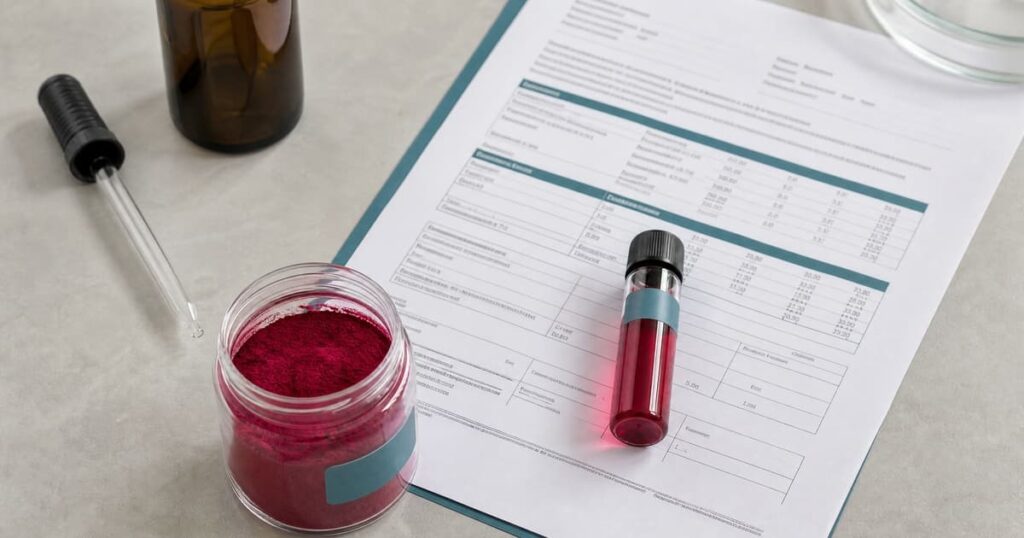
- A batch-specific certificate of analysis showing dye content / colour strength, moisture and heavy-metal limits (arsenic, lead, mercury) and subsidiary dyes.
- A specification sheet, the supplier’s FSSAI licence, and declared shelf life and storage conditions.
- Consistent colour strength batch to batch, so your dosing stays constant and you are not re-tuning the shade with every drum.
- Batch traceability, plus veg/allergen status where your label needs it.
Common formulation mistakes
- Dosing to the concentrate instead of the finished, diluted drink.
- Ignoring the pH shift that natural pigments undergo as acidity changes.
- Skipping a light test in the actual pack, then seeing fade on shelf.
- Assuming a colour permitted in one market is permitted in another.
- Switching supplier without re-checking colour strength and re-standardising the dose.
Sourcing checklist
☐ Water-soluble format suited to a liquid system
☐ Documented food-grade status with batch CoA
☐ Stability data relevant to your pH, light and process conditions
☐ Consistent, declared colour strength for stable dosing
☐ A permitted colour for your destination market
☐ A responsive supplier who can share specifications and samples
A supplier that carries a broad colour range alongside flavours makes it easier to match a shade to a taste profile in one place. Satyasha’s food colours range includes water-soluble options, and pairs with its food flavours for beverage development.
Frequently asked questions :
Q1. Which food colours are permitted in beverages in India?
India permits eight synthetic colours under the FSS (Food Products Standards and Food Additives) Regulations, 2011 — Ponceau 4R, Carmoisine, Erythrosine, Tartrazine, Sunset Yellow FCF, Indigo Carmine, Brilliant Blue FCF and Fast Green FCF — along with a range of permitted natural colours. The specific colour and level allowed depend on the beverage category, so verify against the current FSSAI regulations.
Q2. What is the maximum food colour dosage for a soft drink?
There is no single figure. FSSAI generally limits added synthetic colour to 100 ppm of the finished beverage, with specified products allowed up to 200 ppm. The right dose is set by the target shade within that legal ceiling, and must be confirmed for your exact product category.
Q3. Why does my natural colour fade in a clear bottle?
Usually a combination of light and pH. Many natural pigments are light-sensitive and shift or fade as acidity changes. Use a more stable colour for the conditions, or protect the product with the pack, and always light-test the finished bottle.
Q4. Are natural colours better than synthetic for drinks?
Neither is universally better. Naturals support a cleaner label but are more sensitive to pH, light and heat and often need higher loadings; synthetics are more stable and consistent. The right choice depends on the shade, shelf life, process and positioning.
Q5. Do I need water-soluble or lake colours for beverages?
Most beverages need water-soluble colours, which dissolve cleanly in a liquid. Lake colours are insoluble and are intended for dry mixes and oil-based or coated products.
Getting the colour right
A dependable beverage colour is one that is chosen for the drink’s real conditions, dosed to shade within the legal limit, and backed by consistent supplier documentation. Get those three right and colour stops being a shelf-life risk. Explore Satyasha’s food colours range for water-soluble options, or enquire with your beverage specification to discuss sourcing.