
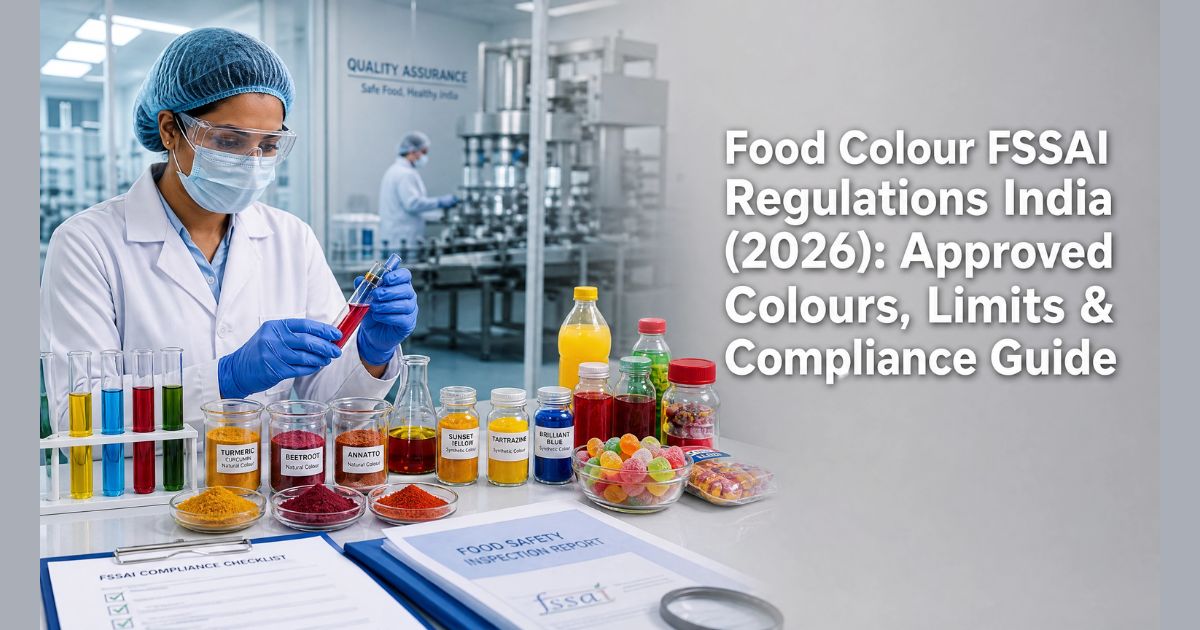
Colour is doing half the selling when you walk into any Indian sweet shop, bakery or beverage section. That bright orange ladoo, that neon-pink candy, that deep red syrup — none of it is an accident. It’s a result of the food business either adhering to or ignoring the food colour FSSAI regulations India has in place to prevent what looks good from becoming what’s harmful. With FSSAI strengthening its framework on food additives in 2026, understanding these rules is no longer optional — it’s the difference between a compliant product and a recalled one.
What is food colouring?
Food colours are additives used to restore, enhance or add colour to food and drink. They do n’t affect taste or nutrition — their sole purpose is visual appeal. Food colours are generally divided into two types: natural colours, derived from plants, minerals or animals (turmeric, beetroot or annatto), and synthetic colours, which are chemically manufactured to produce a stronger, more consistent and cheaper colour. Synthetic colours are dominant in the Indian market because they are heat stable, economical at scale and allow manufacturers to control colours precisely. But that same chemical potency is why they’re tightly regulated.
FSSAI is the Food Safety and Standards Authority of India
The Food Safety and Standards Authority of India (FSSAI) is the statutory body of the Government of India responsible for the regulation and supervision of food safety in India. Established under the Food Safety and Standards Act, 2006, FSSAI decides what can be put in packaged and processed food — including colours, preservatives and flavours — and in what quantity. The rulebook for additives, the Food Safety and Standards (Food Products Standards and Food Additives) Regulations, 2011, is the legal backbone behind every food colour FSSAI regulations India requirement that manufacturers must follow, from raw material sourcing to final packaging.
FSSAI Approved Food Colours
These are additives that are approved for use in certain classes of food only . Each of these colours has a code called INS ( International Numbering System ) and a limit of use . FSSAI approved food colours . Approval is not blanket – a colour allowed in biscuits may not be one allowed in dairy products and the maximum quantity allowed differs by food type. Broadly, the approved list of FSSAI includes :
● Natural colours and colouring matter — carotene and carotenoids (including beta-carotene), riboflavin, caramel, annatto, chlorophyll and curcumin, and more.
● Permitted synthetic colours — a set list of eight dyes approved for use in specified food categories, discussed below.
Any natural or synthetic colour outside this approved list cannot be legally added to food being sold in India – regardless of how common its use might be in unregulated or unbranded products.
List of Synthetic Food Colours Allowed in India
Currently, the FSSAI allows eight synthetic colours in food items and these colours are identified by their INS code on the label of the product:
1- Tartrazine (INS 102) — lemon yellow, used in soft drink mixes, custard powder and confectionery.
2- Sunset Yellow FCF (INS 110) — orange-yellow, commonly used in drinks, desserts and sauces.
3- Ponceau 4R (INS 124) – red, used in jellies, wafers, and processed seafood such as frozen shrimps.
4- Carmoisine (INS 122) — dark red, in cookies, concentrated fruit drinks and wafers.
5- Erythrosine (INS 127) — red, in candies, jellies, and flavoured syrups.
6- Brilliant Blue FCF (INS 133) — blue. Used in bakery items, ice creams and bubble gums.
7- Indigo Carmine / Indigotine (INS 132) — blue, used in confectionery and drinks.
8- Fast Green FCF / Green S (INS 143) — green, used in flavour emulsions and candies.
These colours and mixtures made from them can only be used in the specific food categories and quantities notified by FSSAI and not in every product that a manufacturer makes.
Maximum Permissible Levels
That’s where most compliance mistakes happen. FSSAI has fixed a general ceiling of 100 ppm (parts per million) for permitted synthetic colours in most standardised foods, which goes up to 200 ppm for certain categories such as synthetic syrups, carbonated fruit beverages and water-based soft drinks. Some products have their own specific caps, for example, frozen shrimp is capped much lower at 30 mg/kg for Ponceau 4R. FSSAI checks on purity standards as well as quantity: permitted colours must stay within tight limits for heavy metal contamination, generally arsenic below 3 ppm and lead below 10 ppm, as well as zinc and copper residues. A colour may be on the approved list but if these purity thresholds are exceeded it will not comply.
Labelling Requirements :
Adding a permitted colour is only half the job – the other half is declaring it correctly. FSSAI’s Packaging and Labelling Regulations require:
● A clear statement on the pack such as “Contains Permitted Synthetic Food Colour(s)”
● Indication whether the colour used is natural, nature-identical or synthetic.
● Inclusion of the INS code along with the colour name in the ingredient panel.
● Allergen declaration when the colouring agent is obtained from a known allergen source.
Clear, accurate labelling is more than a legal requirement – it creates consumer trust and reduces the risk of penalties during FSSAI inspections or audits.
FSSAI Banned Colours
While some colourants are expressly banned in India due to proven toxicity or carcinogenic potential, they continue to be used in unregulated or unbranded products, particularly sweets, snacks and street food. These are :
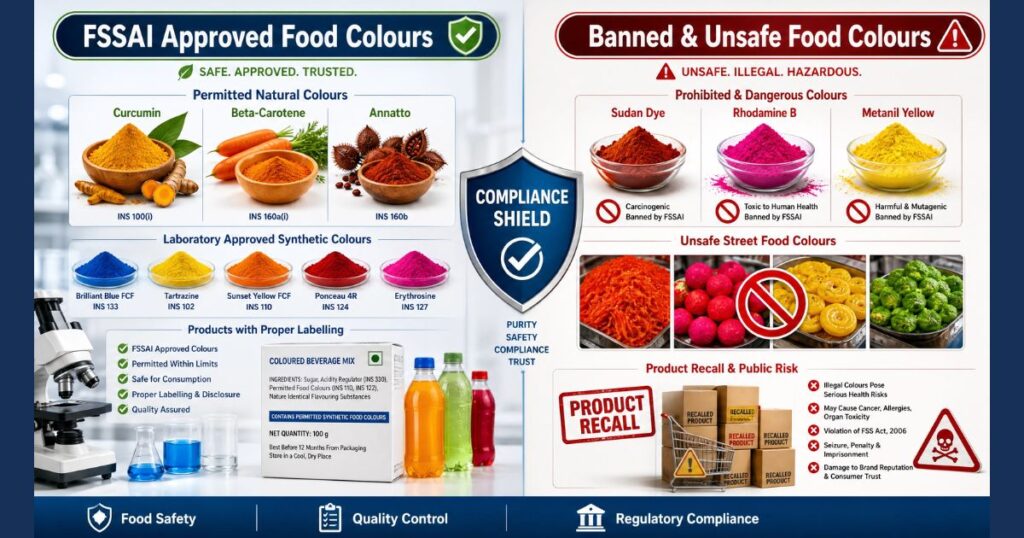
● Sudan dyes (I–IV) – industrial dyes with known carcinogenic potential.
● Rhodamine B — a vivid pink dye still used illegally in cotton candy and some sweets.
● Metanil Yellow – An unauthorised yellow dye that can sometimes be found in turmeric, dals and sweets.
● Coumarin, Dihydrocoumarin and beta-Asarone – restricted because of toxicity profile.
Manufacturers using any of these, even unknowingly through unverified raw material suppliers, are directly exposed to FSSAI penalties, product recalls and damage to reputation.
2026 Regulatory Changes
FSSAI’s First Amendment to the Food Products Standards and Food Additives Regulations, notified in July 2025, comes into effect from February 1, 2026 and brings in some of the most notable changes to food colour rules in recent years. Key updates include:
● Simplified safety footnotes – the older clauses on synthetic colours free from mercury, chromium, aromatic hydrocarbons and cyanides have been removed with safety now directly covered by the 2011 contaminant standards.
● Revised standards for synthetic colour preparations and mixtures – including more precise definitions of acceptable diluents and tighter tolerances for dye content and labelling.
● Greater consistency with international food safety standards as FSSAI continues to revise additive standards in tandem with changes to standards for edible oils, packaged water and processed meat.
This amendment affects any business in India tracking food colour FSSAI regulations and may require formulations, supplier documentation and labels to be subject to a new compliance review before the February 2026 date of enforcement.
How Food Manufacturers Can Remain Compliant
Compliance isn’t approved once and then forgotten; it’s an ongoing process. Manufacturers are expected to :
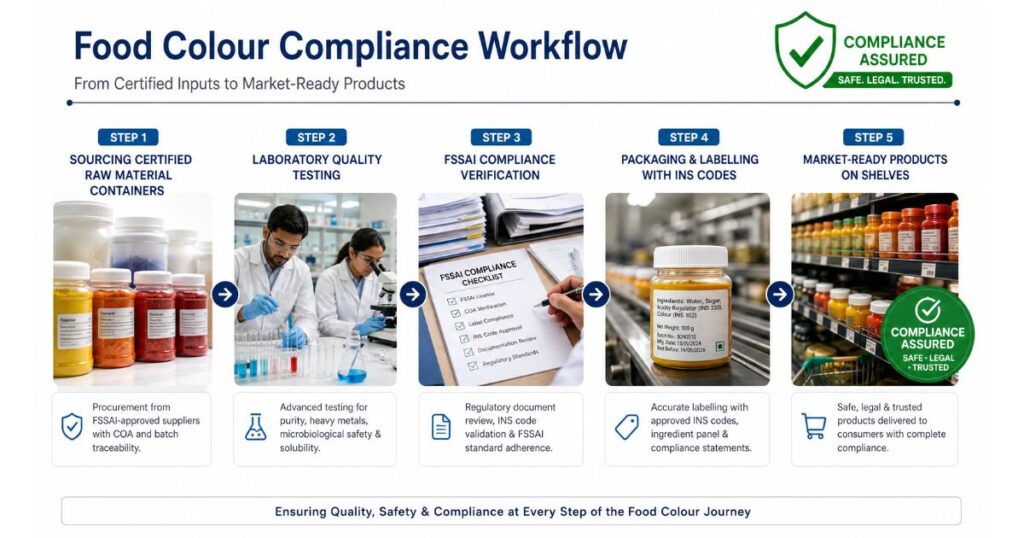
● Source colours only from traceable suppliers with proper documentation accredited by FSSAI.
● Check all colours and amounts against the specific food category they are used in – approval for one product does not mean approval for another.
● Test regularly for heavy metal and purity compliance, not only at launch but through production cycles.
● Update labels to reflect current INS codes and mandatory declarations, particularly after regulatory changes.
● Maintain traceability records for audits, recalls or FSSAI inspections.
“Think of compliance as part of the product design, not an afterthought. It protects consumers and the brand’s market credibility.
Frequently Asked Questions
Q1- Can I use any synthetic colour in my food product?
No. FSSAI has notified the eight synthetic colours to be used only in categories and limits.
Q2- What should I do if I exceed the permitted limit?
This is a violation of regulations and can lead to penalties, seizure of products or licence action under the FSS Act.
Q3- Are natural food colours safe to use by default?
Not always. Natural colours have to be on the FSSAI approved list and meet purity standards.
Q4- Should I include INS codes on my label?
Yes, INS codes must be listed with the colour name in the ingredients list.
Q5- Does the February 2026 amendment apply to all food businesses?
“Yes, all the companies using synthetic food colours will have to ensure their formulations and labels are in compliance with the revised norms,”
Easily align yourself with all food colour FSSAI rules and regulations. Satshya Chemical offers FSSAI-approved safe and tested colours. Get it coloured right reach out to us today.