
A soap can smell excellent on the lab bench and disappoint three weeks later on the shelf. The concentrate arrived bright and clean, but the finished bar comes out flat, slightly off, or barely scented. Often nothing was wrong with the fragrance itself. It simply behaved differently once it passed through the formulation and sat through storage in a hot warehouse.
That gap between the smelling strip and the finished product is the real subject of this guide. Choosing a fragrance for soap and detergent is not a sensory shortlist; it is a formulation and sourcing decision. Compatibility with your base, behaviour under processing conditions, stability over shelf life, dosage economics and the experience you want the customer to have all sit inside that one choice. Get it right and fragrance becomes a quiet asset. Get it wrong and it becomes a recurring quality complaint that is expensive to trace.
This article walks through how manufacturers, formulators and procurement teams can approach that decision with more control—and fewer surprises after scale-up.
Why Fragrance Matters in Soap and Detergent Products
For most home-care and personal-care buyers, scent is the first quality signal they can judge without reading a label. It shapes the impression of cleanliness, freshness and value before performance is ever assessed. A well-chosen soap fragrance or detergent fragrance also builds recognition; repeat buyers often identify a product by how it smells as much as by its pack.
Because of this, fragrance deserves to enter the conversation during formulation, not as a finishing touch once everything else is locked. When scent is treated as an afterthought, incompatibilities surface late—usually during a production run or a customer return—when they are hardest and costliest to fix. Bringing it in early lets you test it as part of the actual system it has to survive in.
Understand the Product Formulation Before Choosing a Fragrance
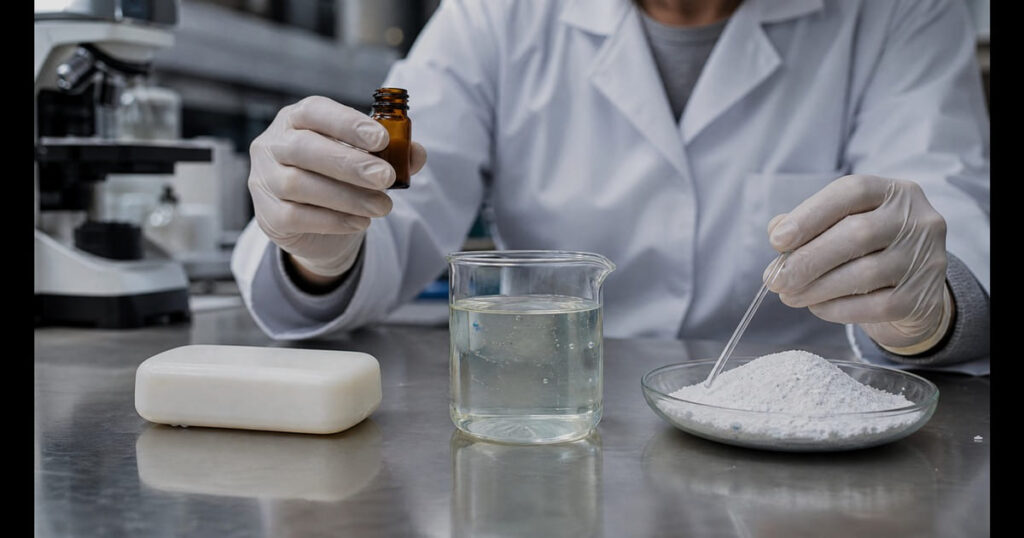
The single most useful habit in fragrance selection is to stop thinking about “a nice scent” and start thinking about “a scent that has to live inside this specific base.” Soap and detergent products are chemically different environments, and even within each category the process varies from plant to plant.
Bar Soap
Finished bar soap is generally alkaline, and that environment can influence how certain fragrance components behave over time. Some ingredients hold up well; others may shift in character or contribute to discolouration, depending on the composition of both the fragrance and the base. Processing adds another variable—mixing, milling and drying subject the fragrance to mechanical and thermal stress before the bar is even stamped.
None of this means a category of scent is automatically unsuitable. It means the fragrance should be evaluated in your soap, at your dosage, and then observed through storage rather than judged on the strip alone.
Liquid Detergent
Liquid detergents are surfactant-based systems, and here the practical questions are about compatibility and appearance. Will the fragrance disperse or solubilise cleanly in the system, or will it need help staying uniformly distributed? Does it hold the product’s clarity, or can it cloud or affect phase stability at your use level? A fragrance that smells right but destabilises the appearance of the product creates a different, equally serious quality problem.
Because liquids are often stored for months, phase and odour behaviour should be checked over time, not only at the moment of blending.
Powder Detergent
In powders, retention is the recurring theme. Fragrance has to survive blending and then hold its character through packaging and storage, where exposure to air, heat and humidity can gradually change a scent profile. How fragrance is introduced varies by operation, and processing conditions differ between plants, so the impact of heat or handling depends on the specific method used rather than one universal rule.
The useful takeaway across all three is the same: match the fragrance to the real conditions of your process and storage, and confirm it there.
7 Key Factors to Consider When Choosing a Fragrance
Most selection mistakes trace back to weighing one factor and ignoring the rest. These seven are worth reviewing together for any candidate.
- Formulation and compatibility. The fragrance has to be evaluated inside the actual base—soap, liquid or powder—because compatibility is a property of the whole system, not the fragrance in isolation.
- pH and chemical environment. Alkaline soap and surfactant-heavy detergents present very different conditions, and certain fragrance components can respond differently across them.
- Processing conditions and temperature. Heat, shear and drying can affect more volatile top notes, so a fragrance should be assessed after it has been through your process, not before.
- Desired fragrance profile. The scent has to fit the product’s positioning and the expectations of its market, which is a commercial decision as much as a technical one.
- Stability and shelf-life performance. How the scent holds up over storage often matters more than how strong it is on day one.
- Regulatory and usage requirements. Applicable usage guidance and destination-market requirements can vary, so these should be confirmed rather than assumed.
- Cost and commercial viability. The meaningful figure is cost per finished unit at a dosage that actually performs—not the headline price per kilo of concentrate.
Popular Fragrance Profiles for Soap and Detergent Products
Certain families recur across home-care and personal-care ranges because buyers associate them with cleanliness and freshness :
- Citrus — bright, energetic, widely used for a “fresh and clean” cue
- Floral — soft and familiar, common in personal-care soaps
- Fresh / clean — aquatic and soapy accords built around a washed feeling
- Herbal — green and slightly medicinal, often read as natural
- Fruity — sweeter, approachable notes with broad appeal
- Warm / oriental — richer profiles used where a product wants a more premium impression
Treat these as starting points, not prescriptions. A profile that works beautifully in one product can underperform in another because of positioning, target market or formulation compatibility. Final selection still comes down to how a specific composition behaves in your specific base.
Essential Oils vs Synthetic Fragrance Compositions
This comparison is often reduced to slogans—“natural is safer,” “synthetic is more stable”—and both are unreliable. Suitability depends on the individual material, your formulation and your commercial requirements, not on the natural-versus-synthetic label.
| Consideration | Essential oils | Synthetic fragrance compositions |
|---|---|---|
| Source | Derived from botanical raw materials | Formulated from aromatic chemicals and blends |
| Consistency | Can vary with crop, region and season | Can be formulated for batch-to-batch consistency |
| Cost | Depends heavily on the specific oil | Depends on the specific composition |
| Stability in base | Varies by constituent and formulation | Varies by composition and formulation |
| Scent range | Bound to what nature provides | Can be engineered to a target profile |
| Positioning | Supports “natural” claims where appropriate | Flexible across price and product tiers |
Many manufacturers use both, sometimes together—an essential oil for a natural claim, supported by a synthetic composition for consistency and performance. The right answer is the one that holds up in your product, meets your positioning and can be supplied reliably at the quality you need. If you’re weighing individual aromatic materials rather than finished blends, this overview of aromatic chemicals and how to source them is a useful companion read.
How Base Chemicals Can Affect Formulation Consistency
Fragrance rarely fails in a vacuum. When a batch smells “different” for no obvious reason, the variable is sometimes the fragrance—and sometimes the consistency of everything around it. If your base inputs drift from batch to batch, you lose the stable reference you need to judge whether a fragrance is performing, which turns troubleshooting into guesswork.
This is why raw material specifications matter beyond the fragrance line item. Humectants, solvents and carriers such as refined glycerine and propylene glycol are common in soap and detergent formulations, and propylene glycol in particular is sometimes used as a diluent or carrier in fragrance and formulation contexts. Their job is to behave predictably. When their grade or specification varies, formulation behaviour can vary with it, and a scent issue may actually be a base-consistency issue wearing a disguise.
To be clear, that is a point about reproducibility, not a claim that glycerine or propylene glycol universally react with fragrance compounds or directly cause scent fading—outcomes there depend on the specific formulation. If you’re deciding between the two materials, this comparison of propylene glycol vs glycerine covers where each tends to fit. The practical rule is simple: control your inputs so that when something does change, you can find it quickly.
How to Test a Fragrance Before Full-Scale Production
Bench approval is not production approval. A short, disciplined evaluation catches most problems while they are still cheap to fix.
- Evaluate in the real formulation. Assess the fragrance inside your actual base, not on a strip or in a neutral carrier.
- Dose to supplier guidance. Trial at concentrations recommended by the supplier for your product category rather than a fixed universal figure.
- Observe the whole product. Check odour, appearance, colour and any effect on the formulation’s behaviour—not scent alone.
- Run it through processing. Evaluate performance after the mixing, heating or drying steps the product will actually go through.
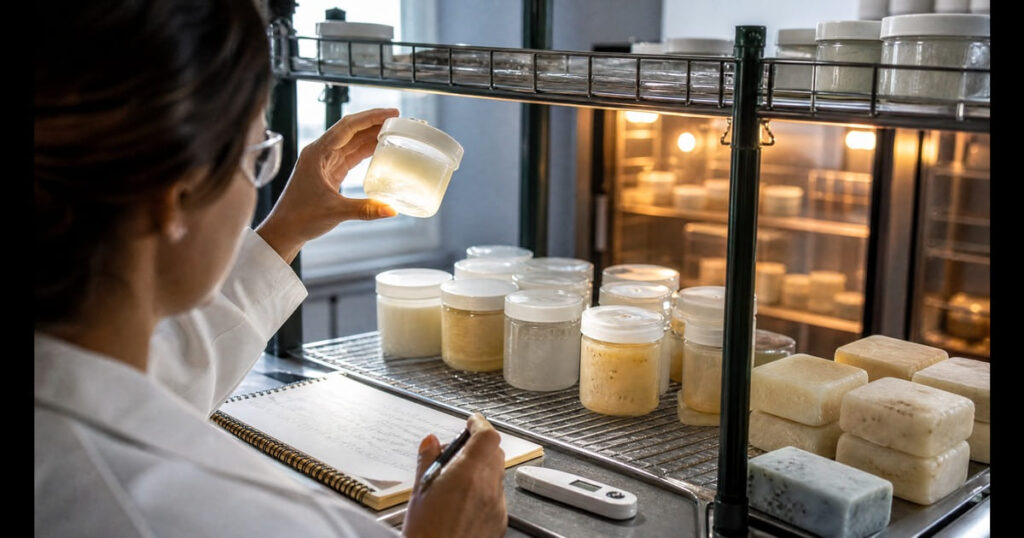
- Test stability under storage. Hold samples under conditions relevant to your market, including realistic heat and humidity.
- Compare over time. Re-assess at intervals so you can see how the scent and product evolve across shelf life.
- Review before scale-up. Sign off on the combined results—compatibility, appearance and stability—before committing to a production run.
Adapt this to your product and market. Storage and evaluation conditions should reflect where the product is actually sold, not a single fixed protocol.
Common Mistakes Manufacturers Make When Selecting Fragrance
- Judging a fragrance by smelling the concentrate instead of the finished product
- Skipping compatibility testing in the actual base
- Ignoring supplier-recommended usage levels and application guidance
- Scaling up before any real stability evaluation
- Choosing raw materials on purchase price alone rather than cost per finished unit
- Letting base raw material specifications drift, then blaming the fragrance
- Overlooking the target market and positioning the scent is meant to serve
Fragrance Selection Checklist for Manufacturers
Use this as a go/no-go before approving any fragrance for production :
- ☐ Product type confirmed (bar soap / liquid detergent / powder detergent)
- ☐ Base formulation documented and stable
- ☐ Processing conditions accounted for (heat, shear, drying)
- ☐ Target pH / chemical environment noted where relevant
- ☐ Fragrance profile matched to product positioning
- ☐ Compatibility tested in the actual formulation
- ☐ Supplier usage guidance obtained and followed
- ☐ Applicable usage restrictions reviewed for your market
- ☐ Stability confirmed under realistic storage conditions
- ☐ Colour and appearance checked in the finished product
- ☐ Shelf-life expectation defined and tested against
- ☐ Cost calculated per finished unit at working dosage
- ☐ Documentation (specs, COA, SDS) available where applicable
- ☐ Batch-to-batch consistency verified across samples
- ☐ Supply reliability and volume capability confirmed
What to Ask a Fragrance or Raw Material Supplier
A short list of the right questions separates a reliable supply relationship from a recurring problem. Not every situation calls for every document, but you should know which apply to yours before you buy :
- What are the product specifications, and how are they maintained batch to batch?
- What application and product categories is this suited to?
- What usage level do you recommend for my product type?
- Can you provide technical documentation and, where applicable, a Certificate of Analysis (COA)?
- Is an SDS / MSDS available for safe handling?
- What compliance documentation is relevant for my market or export destination?
- How is the material packaged, and what is the minimum order quantity?
- What is your supply capability at the volumes and frequency I need?
For a broader view of vetting a supplier beyond fragrance alone, this guide on choosing an industrial chemical supplier is worth reviewing.
Sourcing Fragrances and Raw Materials for Soap & Detergent Manufacturing
Once you know what your formulation needs, sourcing becomes a matter of matching a supplier to those requirements—product relevance, consistent specifications, available documentation, technical information and the ability to supply at your working volumes. A supplier who can speak to how a material behaves in application, not just quote a price, saves a great deal of downstream trouble.
Satyasha Chemicals supplies materials used across soap and detergent manufacturing, including fragrances, aromatic chemicals, essential oils, and formulation inputs such as refined glycerine and propylene glycol. The company operates as an exporter, distributor and wholesaler serving industries including personal care, home care and industrial manufacturing, and maintains a dedicated soap & detergent product category for buyers sourcing raw materials in this space.
If you are evaluating fragrance and raw material options for a soap or detergent line, you can share your requirements with the Satyasha team and request a quote or get in touch to discuss product suitability, specifications and supply.
Frequently Asked Questions
What type of fragrance is suitable for soap manufacturing?
There is no single answer—suitability depends on your base, processing and target market. The reliable method is to evaluate a candidate inside your actual soap formulation at the recommended dosage, then confirm it through storage before committing.
Can the same fragrance be used in soap and detergent?
Sometimes, but not automatically. Soap and detergent are different chemical environments, so a fragrance that performs in one should be tested separately in the other rather than assumed to transfer.
How is fragrance dosage determined?
Dosage depends on the product category, the fragrance composition and supplier guidance. Rather than applying a universal percentage, trial at supplier-recommended levels for your product type and adjust based on performance and cost per finished unit.
How do manufacturers test fragrance stability?
By holding finished samples under storage conditions relevant to their market—including realistic heat and humidity—and re-assessing odour, colour and appearance over time before scaling up.
Are essential oils better than synthetic fragrance compositions?
Neither is universally better. Essential oils and synthetic compositions each have trade-offs in consistency, cost, stability and profile, and the right choice depends on your formulation and commercial requirements.
Can formulation ingredients affect fragrance performance?
They can influence overall formulation behaviour and consistency, which is why stable, well-specified base inputs matter. Whether a specific ingredient affects a specific fragrance depends on the formulation and should be evaluated rather than assumed.
What should manufacturers ask a fragrance supplier?
At minimum: product specifications, recommended usage level and application, available technical documentation such as a COA and SDS where applicable, packaging, minimum order quantity, batch consistency and supply capability.
Does Satyasha Chemicals supply relevant raw materials for soap and detergent manufacturing?
Yes. Satyasha supplies fragrances, aromatic chemicals, essential oils, refined glycerine and propylene glycol, and maintains a dedicated soap & detergent product category. You can request a quote to discuss specific requirements.
Conclusion
Choosing a fragrance for soap and detergent is not about picking the strongest or most pleasant sample on the desk. It is about selecting a scent that stays compatible with your base, survives your processing, holds up through shelf life, and can be supplied consistently at a cost that works per finished unit. The manufacturers who avoid recurring scent complaints are usually the ones who test in the real formulation, follow supplier guidance on dosage, and keep their base raw material specifications under control.
If you’re sourcing fragrance and supporting raw materials for a soap or detergent line, talk to the Satyasha Chemicals team about product suitability and supply—request a quote with your requirements to get started.