
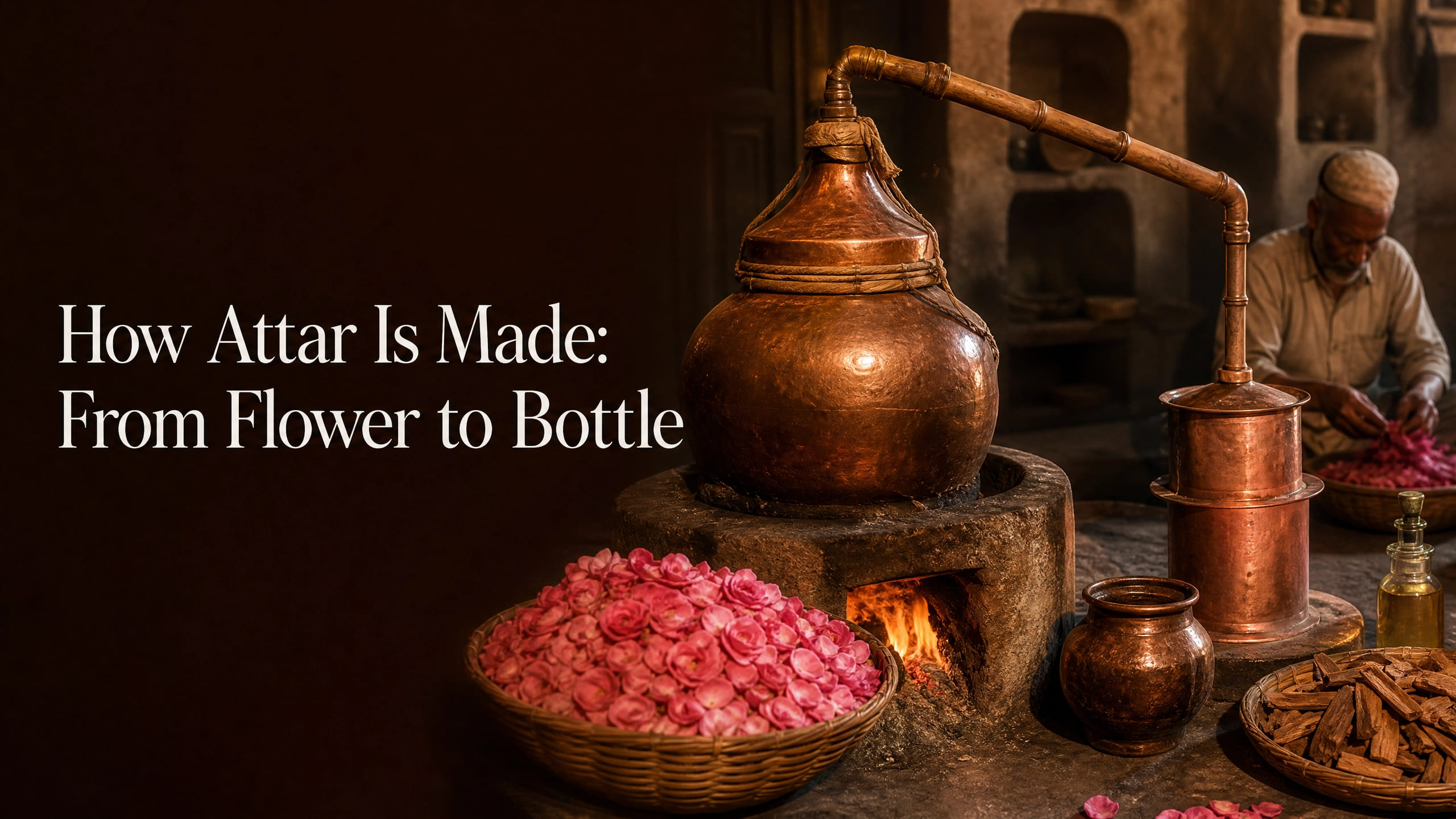
Ask most people how attar is made and you’ll hear some version of “flowers soaked in oil.” The real process is closer to a slow, wood-fired distillation that can run for days and depends as much on the person tending the fire as on the flowers themselves.
Traditional attar is not an infusion. It is a distilled fragrance—captured vapour by vapour into a base oil, then left to mature until the scent settles into its final character. This guide walks through that process from flower to bottle, separates it clearly from modern fragrance oils and formulations, and looks at where today’s fragrance raw materials fit into the wider picture.
What Is Attar?
Attar (also spelt ittar or itra) is an oil-based fragrance. In traditional Indian perfumery, aromatic compounds from flowers, herbs, spices, woods or roots are distilled directly onto a base oil rather than dissolved in alcohol. The base captures and holds the scent, which is why a good attar is concentrated and long-lasting, and why a single drop goes a long way.
That oil base is the main point of difference from a conventional perfume or eau de parfum, which is built on alcohol and water. A traditional attar contains no alcohol at all.
It’s worth being honest about terminology, though. “Attar” is used loosely in the market today, and not every product sold under the name is made the traditional way—some are modern fragrance oils or blends. That doesn’t make them inferior; it simply means the label alone doesn’t tell you how a given product was produced. Suppliers such as Satyasha list attars alongside essential oils and fragrances as distinct categories for exactly this reason.
Why Kannauj Is Central to Indian Attar Making
Most conversations about traditional attar lead back to Kannauj in Uttar Pradesh, long known as the “Perfume Capital of India.” The town has distilled fragrances for generations, with roots often traced to the Mughal era, and much of its output still relies on the same hand-tended distillation described below.
Kannauj’s standing is also formally recognised. “Kannauj Perfume” holds a Geographical Indication (GI) registration granted in 2014, which ties the name to perfume made in the region using its traditional methods—similar in principle to how Champagne or Darjeeling tea are protected. The Government of India also set up the Fragrance & Flavour Development Centre (FFDC) in Kannauj in 1991, under the Ministry of MSME, to support training and technical development in the industry.
A fair way to put it is that Kannauj is strongly associated with the survival of traditional Indian attar-making—not that it single-handedly invented perfumery, which has far older and wider origins.
How Traditional Attar Is Made: Step by Step
The traditional technique is called deg-bhapka, a form of hydro-distillation carried out in copper vessels. The equipment is simple; the skill is in the control. Here is how a batch typically comes together.
Step 1 — Selecting and preparing the botanical material
Everything starts with the raw material—rose or jasmine petals, vetiver (khus) roots, herbs, spices, woods, or even baked earth for the monsoon-scented mitti attar. Flowers are usually picked in the early morning and processed quickly, because delicate florals lose aromatic quality as they wilt. The condition of the botanical going in sets the ceiling on the fragrance that can come out.
Step 2 — Loading the deg
The prepared material is placed with water into a deg, a rounded copper still. The lid is sealed with a paste of clay and cotton so vapour can’t escape at the join. The deg is the distillation vessel, and its copper construction and shape help distribute the gentle heat the process needs.
Step 3 — Heating and releasing the aromatic compounds
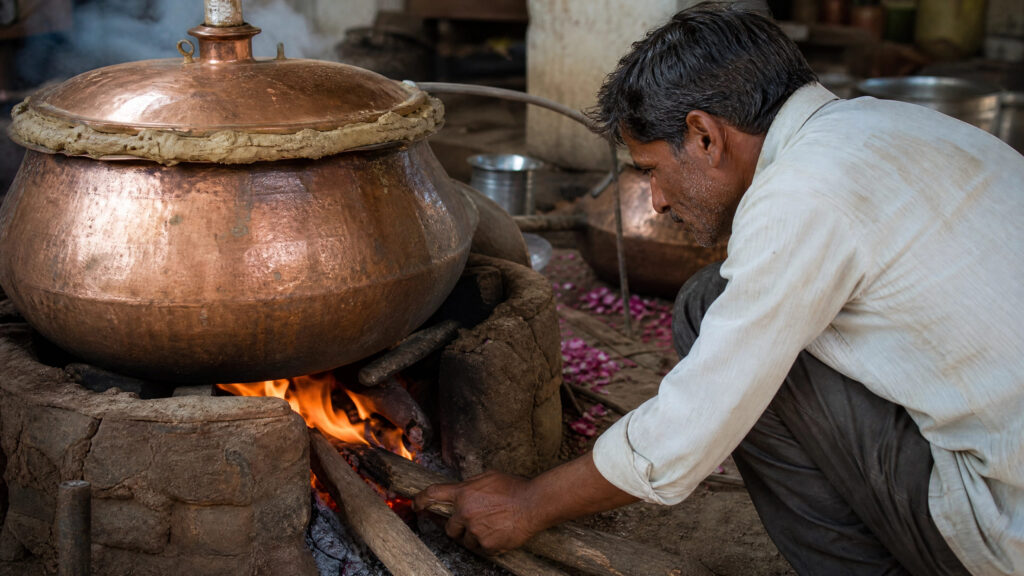
A controlled fire—traditionally wood or cow-dung cakes (kande)—is lit beneath the deg. As the water and botanical material heat, volatile aromatic compounds lift off with the rising steam. Because the material sits in water rather than being exposed to dry steam alone, the method is best described as hydro-distillation. Managing the fire is the distiller’s craft: too fierce and the scent scorches, too weak and it stalls.
Step 4 — Vapour transfer through the chonga
The aromatic vapour leaves the deg through a chonga—a hollow bamboo pipe that connects the still to the receiver. The chonga is usually cooled, often by resting in a trough or tank of water, so the hot vapour begins to lose heat on its way across.
Step 5 — Condensation in the bhapka
The vapour arrives in the bhapka, a copper receiving vessel that has been charged in advance with a base oil—traditionally sandalwood oil. As the vapour condenses inside the cooled bhapka, the aromatic molecules are taken up by the base oil while the accompanying water separates out. The base does the essential work here: it captures and fixes the fragrance instead of letting it flash off.
Step 6 — Repeated distillation charges
A single pass rarely gives a finished attar. The same base oil is exposed to successive fresh charges of botanical material over multiple cycles, building the fragrance up layer by layer until it reaches the desired strength. How many charges are used depends on the botanical and the intensity the distiller is aiming for—there is no single “correct” number that applies to every attar.
Step 7 — Maturation
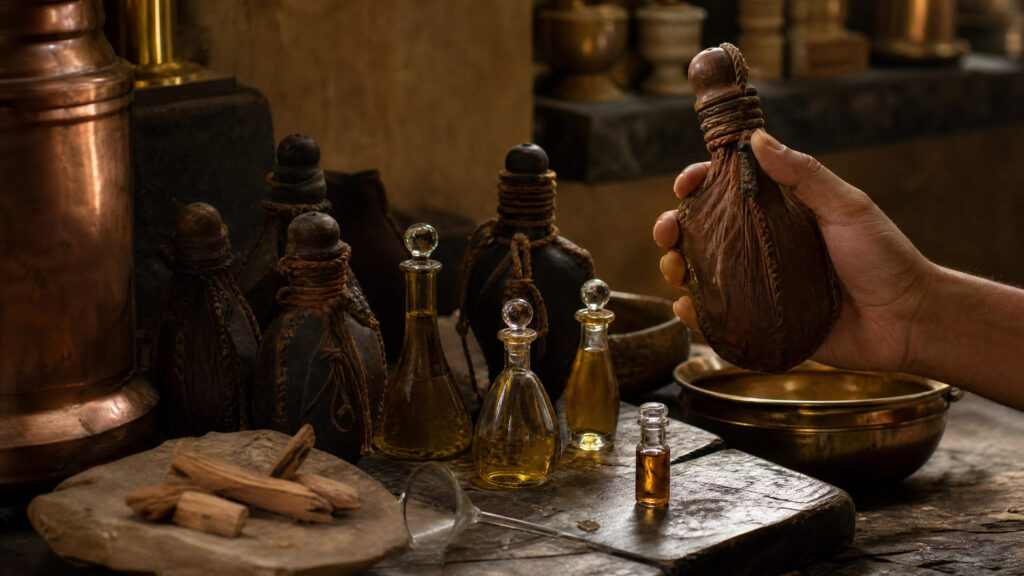
Once the base has taken up enough fragrance, the attar is separated and allowed to rest. Traditionally it is stored in kuppi—leather or camel-skin bottles—whose porous walls let residual moisture escape while the scent settles. Attar character often evolves during maturation, but “longer is always better” is a myth; the right maturation depends on the material and the result the maker wants.
Step 8 — Storage and final preparation
The matured attar is filtered and stored away from excessive heat and light, both of which can degrade a natural fragrance over time. From there it is bottled for use or supply. Because traditional yields are small—large quantities of petals produce only a little oil—the finished product carries the cost of every careful step behind it.
Traditional Attar vs Modern Fragrance Oils
Both have a place. The distinction is about method and consistency, not about one being universally “better” than the other.
| Aspect | Traditional attar | Modern fragrance oils |
|---|---|---|
| Production method | Hydro-distillation (deg-bhapka) onto a base oil | Blended or compounded fragrance formulations |
| Base / carrier | Traditionally sandalwood oil (or other natural base) | Various carriers/solvents chosen by application |
| Formulation | Minimal; scent built through distillation | Often deliberately formulated for a target profile |
| Consistency | Varies with botanical crop and process | Can be engineered for batch-to-batch consistency |
| Typical use | Heritage/natural perfumery, niche products | Broad use across personal care, home care, industry |
| Link to tradition | Direct | Modern practice; may draw on traditional notes |
Neither approach makes the other obsolete. Many products in the market today draw on both traditions.
Why Sandalwood Oil Has Traditionally Been the Base
Sandalwood oil (from Santalum album) became the classic attar base for practical reasons. It has a soft, low-key aroma of its own, so it doesn’t fight the flower it’s meant to carry, and it acts as a natural fixative that holds volatile floral notes and slows their evaporation. Its santalol-rich profile also blends smoothly with a wide range of botanicals. Satyasha lists sandalwood oil among its fragrance materials, reflecting its continued relevance in the sector.
Supply, however, is a real constraint. Indian sandalwood is a slow-growing, high-value species under sustained demand pressure, and a peer-reviewed review of Indian sandalwood cultivation documents how declining supply and rising prices have followed decades of over-harvesting, disease and tight controls. Production and trade are governed by state-specific regulations, and in recent years several states have eased rules to allow more private cultivation. The practical upshot for makers is that genuine sandalwood oil is costly, which is one reason some producers work with other natural bases depending on the product and budget.
A related point of vocabulary: a pure distilled aromatic oil on its own is often called a ruh (for example, ruh gulab from rose), while an attar specifically refers to that aroma distilled onto or combined with a base.
What Determines Attar Quality?
Quality is the sum of the whole process, not a single ingredient. The factors that matter most:
- Botanical quality and freshness. Wilted or mishandled raw material caps the result before distillation even begins.
- Process control. Steady heat, clean vessels and careful timing shape how faithfully the scent is captured.
- Base-oil quality. A clean, well-chosen base holds the fragrance without adding off-notes.
- Number of charges. More cycles can build intensity, though the right number varies by botanical.
- Maturation. Appropriate resting lets the scent settle—judged by outcome, not a fixed clock.
- Storage and packaging. Protection from heat, light and moisture preserves the fragrance over time.
- Batch consistency. For any commercial supply, repeatability matters as much as a single good batch.
Common Mistakes in Attar and Fragrance Production
- Starting with poor-quality or wilted botanical material
- Losing control of the fire, so heat runs too high or too uneven
- Using an unsuitable or low-grade base material
- Rushing maturation and bottling before the scent has settled
- Storing product in heat or light that degrades the fragrance
- Failing to keep batches consistent for commercial supply
- Choosing fragrance or raw materials without testing them in the actual application
Where Modern Chemical Raw Materials Fit Into Fragrance Manufacturing
Traditional attar-making and modern fragrance formulation are related crafts, but they are not the same process—and this is where careful language matters. Modern fragrance, cosmetic and home-care products often use carrier and solvent systems chosen for a specific application, which is a different job from the sandalwood base used in classical attar.
Materials such as refined glycerine and propylene glycol appear widely in modern personal-care and formulation contexts—as humectants, solvents or diluents—where they suit the product being made. They are not traditional attar bases, and they are not universal substitutes for sandalwood oil in deg-bhapka distillation. Whether either is appropriate depends entirely on the formulation and its intended use; a helpful primer on the differences is this comparison of propylene glycol vs glycerine.
The broader takeaway: modern raw materials expand what fragrance and personal-care manufacturers can build, but they belong in their own formulation context rather than being read back into traditional attar production.
What Should Manufacturers Check When Sourcing Fragrance Raw Materials?
For B2B buyers, the material is only as reliable as the supply behind it. Not every document applies to every material, but you should know which ones apply to yours:
- Suitability for your specific product and application
- Clear specification and relevant purity or quality parameters
- Batch-to-batch consistency across supply
- Supplier documentation, including a Certificate of Analysis (COA) where applicable
- Safety Data Sheet (SDS/MSDS) where applicable
- Recommended usage level or application guidance where relevant
- Any regulatory requirements for your market or export destination
- Packaging, minimum order quantity (MOQ) and storage requirements
- Supply continuity and access to technical support
Satyasha Chemicals and Fragrance Raw Materials
Most fragrance and personal-care manufacturers don’t run their own distillery—they rely on suppliers for consistent raw materials. That’s the practical reason to work with a chemical and raw-material supplier: relevant product range, dependable specifications, and clear product information for sourcing decisions.
Satyasha Chemicals, based in Kanpur, supplies materials used across fragrance, personal-care and industrial applications, including fragrances, aromatic chemicals, essential oils, sandalwood oil, and formulation inputs such as refined glycerine and propylene glycol. The company operates as an exporter, distributor and wholesaler, and lists attars among its product categories.
If you’re evaluating fragrance or raw-material options for a specific product, you can share your requirements and request a quote, or get in touch to discuss product suitability, specifications and supply.
Frequently Asked Questions
Q1. How is traditional attar made?
Through deg-bhapka hydro-distillation: botanical material is heated with water in a copper still (deg), the aromatic vapour travels through a bamboo pipe (chonga) into a receiver (bhapka) charged with a base oil—traditionally sandalwood—which captures the fragrance. The base is re-exposed to fresh material over several cycles, then the attar is matured, filtered and stored.
Q2. What is the deg-bhapka process?
It is the traditional Indian method of making attar. “Deg” is the copper distillation vessel, “bhapka” is the copper receiver holding the base oil, and the two are joined by a bamboo pipe called a chonga. It is a form of hydro-distillation rather than dry steam distillation.
Q3. Why is sandalwood oil traditionally used in attar?
Sandalwood oil has a soft aroma of its own, acts as a natural fixative that holds volatile floral notes, and blends well with many botanicals—making it an effective base. Cost and constrained supply are why some makers now use other natural bases depending on the product.
Q4. How long does attar take to mature?
There is no universal figure. Maturation time depends on the botanical and the character the maker is after, and it is judged by the result rather than a fixed period. Longer maturation is not automatically better.
Q5. Is attar made only from flowers?
No. Attars are made from many botanicals—roses and jasmine, but also vetiver (khus) roots, herbs, spices and woods, and even baked earth in the case of mitti attar.
Q6. What is the difference between attar and perfume?
Traditional attar is an oil-based, alcohol-free fragrance distilled onto a base oil. A conventional perfume or eau de parfum is alcohol-based. Attars are typically more concentrated as a result.
Q7. Can modern fragrance products use different carrier materials?
Yes. Modern fragrance, cosmetic and home-care products may use various carriers or solvents chosen for the application. These are separate from the traditional sandalwood base and are not substitutes for it in classical attar-making.
Q8. Does Satyasha Chemicals supply raw materials relevant to fragrance formulations?
Yes. Satyasha supplies fragrances, aromatic chemicals, essential oils, sandalwood oil, refined glycerine and propylene glycol, and lists attars among its categories. You can request a quote to discuss specific requirements.
Conclusion
Traditional attar is a distilled craft, not a simple soak. It rests on good botanical material, patient control of the deg-bhapka distillation, a well-chosen base such as sandalwood oil, and unhurried maturation—each step compounding into the final scent. Modern fragrance manufacturing builds on that heritage with its own materials and formulation systems, where consistency and the right raw-material choices carry the weight.
If you’re sourcing fragrance or raw materials for a personal-care, home-care or industrial product, talk to the Satyasha Chemicals team about what fits your formulation—request a quote with your requirements to start the conversation.